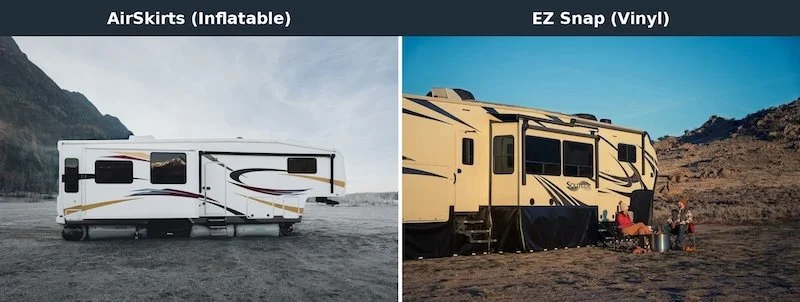
EZ Snap vs. AirSkirts RV Skirting : Which Is Better?
I spent over four years living in my fifth wheel full-time, and a good chunk of those winters RVing were spent chasing — or occasionally not chasing fast enough — cold weather. Skirting was never optional; it was the difference between a functioning water system and a frozen one, and I found that out the hard way the first year, when a gap at one corner let enough wind through to freeze a low-point drain valve overnight. I've dealt with vinyl skirts stapled to homemade frames, snap-on kits, and inflatable setups since then, and I've watched the RV skirting market change a lot in that time. Two of the products people ask me about most now are EZ Snap and AirSkirts, so here's a real head-to-head, based on how each one actually performs when you're relying on it every day — not just how it looks in a product photo.
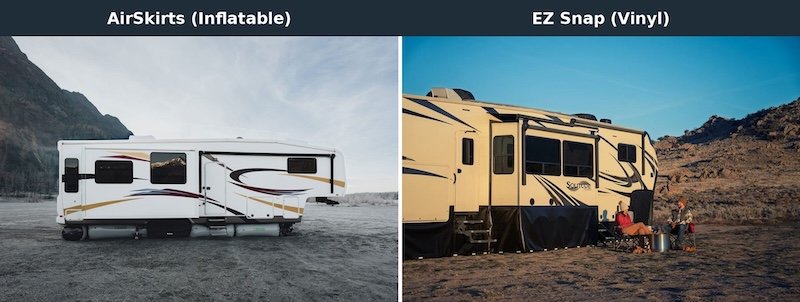
Is AirSkirts Better Than EZ Snap?
AirSkirts is the better fit for full-timers and frequent movers who need a fast, tool-free setup with zero permanent changes to the RV exterior. EZ Snap is the better fit for RVers parking in one spot for the winter who want a snug, semi-custom vinyl skirt at a lower upfront cost, and don't mind attaching mounting hardware once. Broadly, EZ Snap kits run in the $800–$2,000 range depending on rig size, while AirSkirts kits run closer to $1,800–$3,500+ for larger RVs — the gap reflects the labor you're buying out of the process, not just the material.
EZ Snap vs. AirSkirts: Cost Comparison
| EZ Snap | AirSkirts | |
|---|---|---|
| Typical cost | ~$800–$2,000 (DIY kit, varies by RV length) | ~$1,800–$3,500+ (varies by RV length and clearance) |
| Installation method | 3M VHB adhesive mounts + snap fasteners (no drilling) | Inflatable PVC tubes, no adhesive or hardware |
| Setup time | A few hours for initial mount; quick snap-on/off after that | Roughly 25–45 minutes, even solo |
| Insulation type | Diamond-Weave vinyl wind barrier | Two layers of PVC with trapped air between them |
| Portability | Folds flat, but sized to your specific RV | Deflates and rolls into storage bags |
| Best for | Stationary winters, budget-conscious DIYers | Frequent movers, full-timers, no-modification setups |
Which Is Easier to Install: EZ Snap or AirSkirts?
EZ Snap requires an initial investment of time: measuring your rig, cutting the vinyl to length, and mounting the 3M adhesive snap studs around the base. Once that first install is done, taking the skirt on and off for the season (or for a quick furnace repair underneath) is genuinely easy — it's just snapping fabric on and off a frame that's already there.
AirSkirts skips that setup phase entirely. You lay the tubes around the perimeter, inflate them with the included pump, and tuck the corners in. Most people take longer their first time (closer to 45 minutes) and get it down to 20–30 minutes with practice. There's no drilling and nothing left behind on the RV when you take it down, which matters if you're leasing, still under warranty, or planning to sell.
When I was skirting my fifth wheel every fall, the appeal of "no modification" was real — but so was the appeal of not having to inflate and manage tubes in freezing wind. The one fall I mounted a snap-on skirt myself, it took me most of a weekend to get the layout right around the wheel wells and the hitch area, working alone with a tape measure and cold fingers. After that, though, pulling the skirt on each October and off each spring took maybe twenty minutes total. That tradeoff — a rough first install in exchange for effortless seasonal use — is really the crux of the EZ Snap experience. Which one is "easier" ultimately depends on whether you're setting up once for a whole winter or breaking camp regularly.
Insulation Performance: Vinyl vs. Inflatable Tubes
EZ Snap's Diamond-Weave vinyl works as a wind barrier. It stops air infiltration when it's snapped tight against the RV, which is the biggest factor in how warm your underbelly stays — most heat loss under a rig comes from wind moving through the skirted area, not from the material itself lacking insulation value.
AirSkirts' trapped-air design creates a thicker insulating cushion between two PVC layers, similar to how double-pane windows work. It doesn't rely on tight contact with the RV body the way a snap-on skirt does — the air pocket does the insulating.
In practice, both approaches protect pipes and tanks from freezing when installed correctly. The bigger performance differentiator isn't the skirt material — it's whether gaps are sealed at corners, wheel wells, and uneven ground, regardless of which system you choose. That frozen drain valve I mentioned earlier wasn't a failure of the skirting material at all; it was a two-inch gap I'd missed at one corner where the ground dipped. After that, I got obsessive about walking the entire perimeter by hand every single time, checking for daylight, before I'd trust the setup overnight. I lost more heat to gaps I hadn't noticed than to any real difference in R-value between materials.
Durability and Lifespan
EZ Snap's vinyl is designed to hold up over multiple seasons of use, provided the adhesive mounts stay intact and the fabric isn't repeatedly folded in the same spots. AirSkirts' PVC tubing is built with heat-welded seams and pressure-relief valves, but you do need to watch for sharp edges on older or damaged underbellies that could puncture a tube — something the manufacturer specifically warns about.
If you're the type who sets skirting up once in October and leaves it until March, EZ Snap's fixed mounts hold up well. If you're breaking camp and setting up again every few weeks, AirSkirts' quicker teardown reduces wear from repeated handling — but also means more inflate/deflate cycles on the tubes themselves.
The Verdict
Choose EZ Snap if: you're staying in one location for the winter, want a lower upfront cost, and are comfortable with a one-time mounting process.
Choose AirSkirts if: you move every few weeks, don't want anything attached to your RV's exterior, and want the fastest possible setup and teardown.
Neither is "wrong" — they're built for different lifestyles. After four winters of full-time RVing, the honest answer is that the best skirting system is the one that matches how often you actually move, not the one with the flashiest marketing.
FAQ
Is AirSkirts warmer than EZ Snap?
Not inherently — both can keep an underbelly well above freezing when installed without gaps. AirSkirts' trapped-air layer performs well even on uneven ground, while EZ Snap performs best when snapped tightly with no wind gaps.
Does EZ Snap leave adhesive residue on an RV?
The 3M VHB mounting studs are designed for long-term hold rather than easy removal, so some residue or adhesive marks are possible if you remove them later. AirSkirts avoids this entirely since it uses no adhesive or hardware.
Can I use either system on a fifth wheel?
Yes. Both EZ Snap RV skirting and AirSkirts inflatable RV skirting offer kits sized for fifth wheels, travel trailers, and motorhomes — you'll need accurate rig length and ground clearance measurements either way.
How long does each system last?
Both are marketed for multi-year use (EZ Snap's vinyl and AirSkirts' PVC tubing are each designed to survive several winters), though real-world lifespan depends on storage, handling, and exposure to sharp edges or extreme UV.
This page contains affiliate links. That means we earn a small commission if you make a purchase through a link on this page. Thank you for your support!